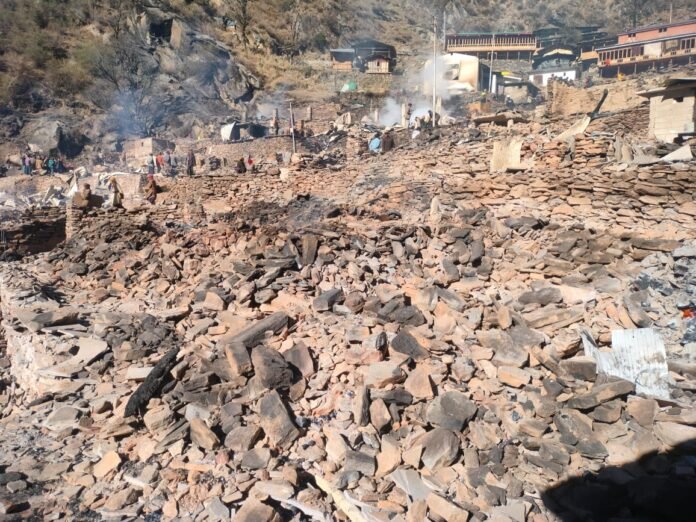
Uttarkashi: A devastating fire in Pawani village of Mori tehsil on Tuesday destroyed 33 residential buildings, leaving 58 families affected and once again highlighting the vulnerability of remote Himalayan settlements to such disasters. A panchayat building and a primary school were also damaged in the incident. Fortunately, no human or livestock casualties have been reported.
For the affected families, the disaster has meant losing their homes and belongings overnight. Many are now facing the difficult task of rebuilding their lives after the blaze reduced their houses to ashes.
The incident is part of a troubling pattern in Mori tehsil, where more than 450 houses have reportedly been destroyed in fire incidents over the past 19 years. Three people have lost their lives, while hundreds of livestock animals have also perished in these tragedies.
Traditional Architecture Adds to the Damage
Nearly 90 per cent of villages in Mori have houses built primarily with deodar and kail wood. The extensive use of timber, combined with closely spaced buildings and narrow village lanes, allows flames to spread rapidly from one house to another.
Nagendra Dutt, president of the Tarun Environmental Science Organisation, which has been working in the region for several years, said many villages have between 80 and 100 houses. An assessment of incidents over the past 19 years suggests that almost all houses in five villages have been destroyed in fires.
He emphasised the need for greater awareness and preventive action among villagers, alongside a concrete administrative plan to reduce such incidents and improve emergency response arrangements.
A History of Repeated Destruction
Mori’s history of devastating fires dates back several years. In 2006, a major blaze in Dhatmir village destroyed 120 buildings, six grain storage structures and seven livestock animals.
In 2007, Osla village lost 53 houses, while 83 animals perished. During 2008, fires affected 44 buildings in Jakhol, eight in Kotgaon, five in Naitwar, two in Bheetri and two in Majoni.
The year 2009 witnessed another major tragedy in Sidri village, where 25 houses were gutted. A father and his daughter died after being trapped in the blaze, while nine animals also lost their lives. The same year, eight houses were destroyed in Suchan village.
In 2011, five houses and 15 animals were lost in Ghara village. Seven buildings were damaged in Paon Talla in 2012, followed by 22 houses in Sunkandi and three in Satoori in 2013.
In 2014, another fire in Jakhol destroyed 16 houses and 13 grain storage structures. The destruction continued in subsequent years, with nine houses gutted in Raikcha in 2016 and four in Seva village in 2017.
One of the worst incidents occurred in Savani village in 2018, when 29 houses were destroyed and around 100 livestock animals reportedly burnt alive.
In 2020, 28 houses were gutted in Masari village, followed by two buildings in Gangad in 2022. During 2024, fires destroyed 14 houses in Salra and three more in Dhatmir.
Savani village witnessed another tragedy in 2025, when nine houses and five grain storage structures were destroyed. A woman died in the incident, while four animals also perished.
Remote Villages Need Better Emergency Preparedness
Despite the long history of such incidents, firefighting facilities remain limited in several remote settlements. Difficult terrain, poor accessibility and inadequate equipment often delay emergency response, allowing damage to escalate.
The Pawani incident has renewed calls for a village-level disaster management strategy. Providing basic firefighting equipment, ensuring access to water, training local volunteers and establishing effective emergency response systems are among the measures that need priority attention.
The administration must work closely with village communities to identify vulnerable settlements and develop preventive arrangements. Without sustained intervention, the recurring destruction of homes and livelihoods will continue to threaten the region’s remote communities.