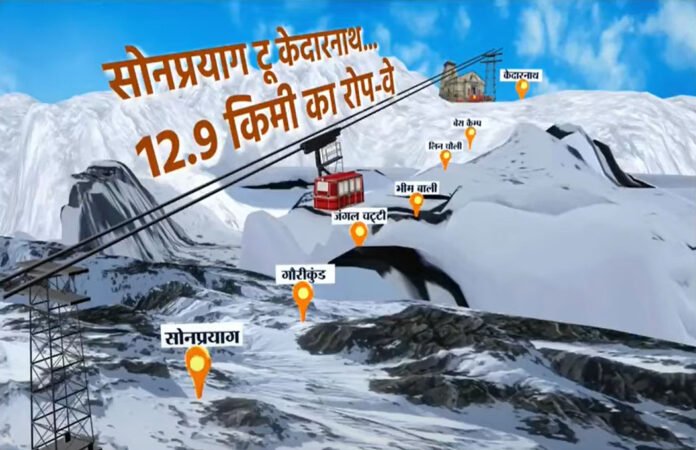
(Mohan Bhulani) Dehradun: The challenging trek to Kedarnath shrine could become a thing of the past in the coming years, with the Central Government planning an innovative funding model for the proposed 12.9-kilometre ropeway project connecting Sonprayag to the Himalayan temple. Under the proposed arrangement, the government will not have to bear the entire construction cost, as private investors are expected to finance the project.
Union Minister for Road Transport and Highways Nitin Gadkari has indicated that the approximately ₹5,000-crore project is being considered under the Build-Operate-Transfer (BOT) model. Under this arrangement, a private investor will invest the entire amount required for construction and pay the government an annual royalty of around ₹800 crore. The company will also be responsible for operating and maintaining the ropeway for a specified period before transferring the project to the government as per the agreement.
The proposed model is expected to create a new revenue stream for the government while reducing the immediate financial burden on the public exchequer. If implemented as planned, the ropeway will significantly transform the pilgrimage experience by reducing travel time to Kedarnath from several hours to less than an hour.
Major Relief for Elderly Pilgrims
Located in the Garhwal Himalayas of Uttarakhand, Kedarnath is one of the most important pilgrimage destinations in the country. At present, devotees travelling to the shrine have to undertake a strenuous uphill trek from Gaurikund, navigating steep mountain paths and often unpredictable weather conditions. The journey can be particularly difficult for elderly pilgrims, children and people with physical limitations.
The proposed ropeway is expected to reduce the journey time dramatically. While the existing journey from Sonprayag to Kedarnath can take approximately eight to nine hours, the ropeway is expected to bring the travel time down to around 36 minutes. Some estimates have also suggested a journey time of approximately 27 minutes, depending on the final route and operational arrangements.
Once operational, the ropeway could make the pilgrimage significantly more accessible, particularly for senior citizens and devotees who find the difficult mountain trek physically demanding. It is also expected to improve the overall transportation infrastructure in the region.
However, the government has not yet announced a definitive timeline for the completion of the project.
What Is the BOT Model?
The Build-Operate-Transfer model is a public-private partnership arrangement in which a private company finances and constructs an infrastructure project. After completing construction, the company operates and maintains the facility for an agreed period, earning revenue from its operations while paying the government the stipulated royalty or other contractual charges. Once the concession period ends, ownership and operational control are transferred to the government in accordance with the agreement.
The proposed arrangement for the Kedarnath ropeway is significant because it could allow the government to develop major infrastructure without directly financing the entire construction cost.
80 Per Cent of Char Dham Highway Project Completed
Gadkari also shared an update on the progress of the Char Dham Highway Project, which aims to improve road connectivity to Kedarnath, Badrinath, Gangotri and Yamunotri. The ambitious project, estimated to cost around ₹12,000 crore, is intended to strengthen transportation infrastructure and make the annual Char Dham pilgrimage safer and more convenient.
According to the minister, approximately 75 to 80 per cent of the project work has been completed. Once the remaining stretches are developed, pilgrims and tourists are expected to benefit from improved road access to the four major Himalayan shrines.
Tunnelling in the Himalayas Remains a Major Challenge
Highlighting the difficulties associated with infrastructure development in mountainous regions, Gadkari said the government is working on tunnel projects worth approximately ₹3 lakh crore, several of which are located in the Himalayan region.
Construction in the Himalayas presents unique engineering challenges, including unstable rock formations, water seepage, landslides and extreme weather conditions. These factors often increase construction costs and extend project completion timelines.
Citing the example of the Zojila Tunnel, Gadkari said that approximately 70 per cent of its construction work had been completed despite the difficult geographical conditions.
The government’s broader infrastructure strategy focuses on improving road and tunnel connectivity, facilitating pilgrimage tourism and strengthening transportation networks in strategically important border regions.
If the Kedarnath ropeway project moves forward under the proposed BOT model, it could become a major milestone in Uttarakhand’s infrastructure development. Apart from making one of India’s most challenging pilgrimages considerably easier, the project could also establish a new model for attracting private investment into large-scale Himalayan infrastructure projects.