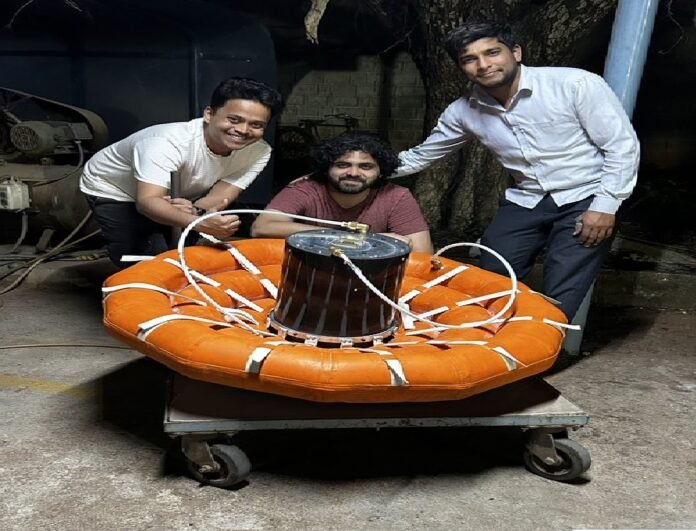
Bhubaneswar: In a notable advance for India’s private space sector, Bhubaneswar-based start-up Serendipity Space has successfully flight-tested a prototype satellite carrying an autonomous pharmaceutical factory designed to grow drug crystals in microgravity-like conditions. The company, founded only in 2024, used a high-altitude balloon at the Tata Institute of Fundamental Research’s Balloon Facility in Hyderabad to send its system to the edge of space, where it operated without human intervention before returning safely to Earth.
Serendipity Space was established by Antariksh Parichha, Jivitesh Debata and Dr. Monica Ekal. The founding team combines expertise in physics, engineering, computer science and space operations. Dr. Ekal brings experience from the German Aerospace Center and NASA. For CEO Parichha, whose academic background includes degrees from Shiv Nadar University and the Technical University of Munich, the venture carries a personal dimension. A brush with cancer led him to examine the manufacturing challenges of immunotherapies. He has cited the development of an easier-to-inject form of the cancer drug Keytruda, achieved through microgravity research on the International Space Station by Merck and NASA, as a key inspiration. That example convinced him that space could serve as a practical manufacturing environment rather than merely a research setting.
The company moved rapidly from idea to demonstration. It raised pre-seed funding from Campus Fund in July 2025, assembled its technical team by October, and built a functional orbital-class satellite prototype in under four months. After about a month of testing, the near-space demonstration took place in March 2026. As of May 2025, dealroom data placed the start-up’s post-money valuation at roughly ₹22.5 crore, reflecting early investor interest in Indian space-pharma technology.
At the heart of the mission was Alchemy, the company’s proprietary autonomous pharmaceutical factory module. Carried inside the satellite prototype, Alchemy ran core drug crystallisation processes independently while the vehicle also tested heatshield and avionics systems required for eventual orbital re-entry. The payload included commercial monoclonal antibody therapeutics, small-molecule drugs and additional proteins intended for drug-discovery research. According to the company, the system continued functioning through the demanding conditions of the flight and preserved the integrity of the crystals through descent, landing and recovery.
The scientific rationale rests on the way gravity affects crystal formation. On Earth, convection currents and sedimentation cause crystals to grow unevenly and incorporate defects. In microgravity these disturbances largely disappear, allowing crystals to form more slowly and uniformly in all directions. The resulting structures are often purer and more ordered without any change to the drug’s underlying chemistry. Better crystals can improve the bioavailability of small-molecule medicines and may eventually enable more stable, high-concentration formulations of protein-based therapies such as monoclonal antibodies, potentially shifting some treatments from lengthy hospital infusions to simpler injections.
Serendipity Space regards the balloon test as a deliberate stepping stone. Its longer-term plan involves orbital missions in which satellites manufacture drug crystals in low Earth orbit and return them to Earth. The successful recovery of the prototype, with heatshield, avionics and Alchemy all performing as intended, provides a technical foundation for that next phase. Space-based manufacturing remains an emerging global field, with the broader market projected to exceed $10 billion by 2030. If the company can demonstrate repeatable and economically viable operations, it could help secure India an early position in a specialised segment of the space economy that few firms worldwide are currently pursuing.