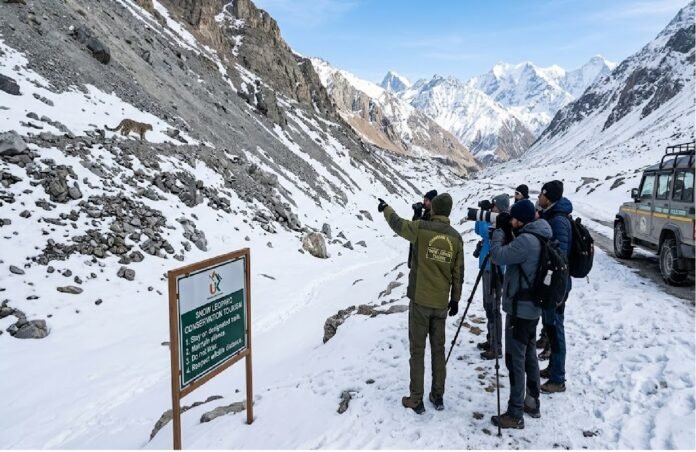
Dehradun: The snow leopard, one of the rarest animals of the high Himalayas, may soon draw more than wildlife enthusiasts and researchers to Uttarakhand. The state has begun preparations to turn the elusive big cat into a tourism attraction. The tourism and forest departments are working together to develop snow leopard sighting in Uttarkashi and in the Darma region of Pithoragarh. If the plan succeeds, tourists will travel to these remote areas to see the animal among the snow-covered peaks.
The government’s effort is not limited to showing tourists a snow leopard. Officials say the initiative is meant to create jobs for local villagers, promote homestays and extend tourism activity in high-altitude areas. The entire arrangement will be modelled on the snow leopard tourism system already developed in Ladakh.
The snow leopard is widely regarded as the most mysterious and rarest wildlife species of the Himalayas. It is usually found in cold, rugged mountain terrain at elevations of roughly 3,000 to 5,500 metres above sea level. Its body is well adapted to icy conditions. A thick coat of fur, a long tail and the ability to blend into rocky surroundings set it apart from other large cats.
Spotting a snow leopard is far from easy, which is exactly why sightings have become a major tourist draw in several parts of the world. Uttarakhand now sees the same opportunity for itself and hopes to open a new avenue for tourism in the state.
Tourism Secretary Dhiraj Garbyal said the purpose of exposure visits is not merely to explain the sighting process to villagers. They will also be trained in tourist safety, maintaining a safe distance from wildlife and the precautions to be observed during sightings.
The state is also planning a special winter event centred on snow leopard sightings. However, the number of visitors will be strictly regulated. Officials stressed that the aim is not to attract crowds but to build controlled and responsible wildlife tourism. Winter is considered a particularly promising season because the chances of spotting the animal in high-altitude areas increase when snow pushes wildlife lower. This could make the season a special attraction for visitors and encourage new tourism activities in remote places such as Uttarkashi and Darma.
The biggest beneficiary of snow leopard sighting is expected to be the local economy. Once tourists reach these far-flung regions, they will need lodging, food, local transport and guides. Demand is likely to rise for homestays, local guides, vehicles, meals, handicrafts and other tourism services. Officials say the effort is to ensure that the economic gains from the animal that draws visitors reach villages directly.
The Tourism Department’s focus is on linking snow leopard conservation with local livelihoods. When villagers become part of tourism activities themselves, their participation in protecting wildlife is also expected to grow stronger.
After studying the community-level model operating in Ladakh, Uttarakhand will build a similar system suited to its own conditions. Villagers will later be provided with cameras and other technical equipment so that the presence and movements of snow leopards can be recorded more effectively.
Scientific work on snow leopard conservation is also moving ahead across the country. So far, 718 snow leopards have been assessed in Ladakh, Jammu and Kashmir, Himachal Pradesh, Sikkim and Uttarakhand.
According to Bilal Habib, a scientist at the Wildlife Institute of India, the plan now is to assess snow leopards simultaneously in all major habitats at regular intervals. This would also allow a comparative study of their numbers and status in different states.
The new assessment will go beyond counting snow leopards in an area. Scientists will also study their habitats, behaviour and the population of herbivorous wildlife that the big cats prey on. Camera traps and other modern technical resources will be used for the exercise. The findings are expected to show which areas the animals use most actively, how their habitats are changing and how their prey species are faring.
Regular, simultaneous assessments are expected to improve snow leopard conservation planning. Scientific data will help identify sensitive areas, protect wildlife habitats and decide limits for tourism activity. A workshop will be held before the work begins, during which the roles of the departments and experts concerned will be defined.
Officials said the snow leopard sighting plan for Uttarkashi and Darma is not just an exercise in showing visitors a rare animal. A larger objective lies behind it: protecting Himalayan biodiversity while raising the incomes of local people. If the Uttarakhand model succeeds along the lines of Ladakh’s, the snow leopard could become the new face of high-altitude tourism in the state in the years ahead.