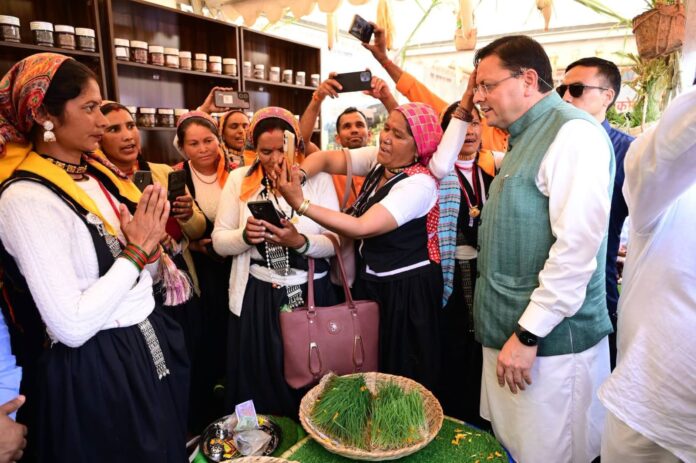
GOPESHWAR : Uttarakhand’s Chief Minister today launched the “Community Seed Bank” project at a multi-purpose camp organized under the Seva Pakhwada initiative in Gopeshwar, Chamoli district. The project marks a significant step toward conserving the traditional agricultural biodiversity and indigenous seed varieties of the Himalayan region.
The launch event was attended by Chamoli in-charge Minister Bharat Chaudhary, the honourable MLAs of Karnaprayag and Tharali, the District Magistrate of Chamoli, the Chief Development Officer of Chamoli, and other public representatives. The initiative, being implemented by the Chamoli Agriculture Department, is financially supported by the International Fund for Agricultural Development (IFAD) and the Uttarakhand State Rural Livelihood Mission (USRLM).
Scope and Targets
Under the project, five community seed banks will be established across the Dashauli, Nandanagar, Karnaprayag, Gairsain, and Deval development blocks of Chamoli district. These seed banks will connect 3,178 farmers across 66 villages, working toward the identification, collection, documentation, and scientific conservation of 144 local and indigenous varieties belonging to 66 traditional crops.
Illustrative List of Key Local Crop Varieties Being Conserved
1. Cereals: Wheat (Local Red, White Local, Himalayan Wheat, Chulia, Jaula); Barley (Himalayan Barley, Hull-less Barley, Black Barley, Baran Barley); Finger Millet (Black Ragi, Red Ragi, Chhota Ragi, and other local Mandua varieties); Buckwheat (Sweet, Bitter, Black); Rice (Chhappan, Jaunsari, Thapchini, Ramjeena, Local Basmati, Kalmi); Maize (Local Yellow, Black, Bhatta Maize).
2. Pulses: Black Gram (Local, Small-grain); Green Gram (Himalayan Moong); Kidney Beans (Local red, white, and black varieties, Jhangora Rajma); Chickpea (Desi, Black); Pea (Local, Himalayan); Black Soybean (Kala Bhatt — a significant local variety).
3. Coarse Grains and Others: Local varieties of sorghum and pearl millet; Amaranth (Red and White); indigenous varieties of sesame, mustard, and Ramtil (Niger seed).
4. Vegetables and Other Crops: Potato (Local Red, Black); traditional varieties of chilli, tomato, and brinjal; Himalayan varieties of garlic and onion; local ginger and turmeric; medicinal and spice crops including local cumin, coriander, and fennel varieties.
5. Special Himalayan Crops: Jhangora (Barnyard Millet); Fapar (buckwheat varieties); Chaulai and Ramdana; various local seed varieties of Panifal and Kafal-related crops.
Rural Development Secretary Dhiraj Garbyal noted that these local crops — particularly coarse grains, pulses, and medicinal plants — are highly resilient to climate variability. Their conservation has become increasingly urgent as indigenous varieties disappear rapidly due to the spread of modern hybrid seeds.
The Chief Minister Pushkar Dhami said Uttarakhand’s traditional seeds form an important foundation for the state’s agricultural heritage, food and nutritional security, and climate-resilient farming. He noted that community seed banks, driven by the participation of local farmers, would play a major role in preserving Himalayan agricultural biodiversity for future generations.
Protecting Agricultural Heritage
Uttarakhand’s Himalayan region is globally recognized for its unique agricultural biodiversity. Local crops such as various coarse grains (finger millet, barley, buckwheat), pulses, vegetables, and medicinal plants are highly resilient to climate variability. The need for their conservation has grown more urgent as indigenous varieties are rapidly disappearing due to the increasing use of modern hybrid seeds.
The IFAD- and USRLM-supported project places emphasis not only on seed conservation but also on improving farmers’ livelihoods, preserving traditional knowledge, and strengthening community participation. The initiative will be implemented through local Farmer Producer Organizations (FPOs) and partner institutions to ensure long-term sustainability.
Why Traditional Seeds Matter
According to experts, traditional seed varieties require less water and fertilizer and possess natural resistance to pests. In an era of climate change, these seeds could prove invaluable for ensuring food security. In remote areas like Chamoli, community seed banks are expected to guarantee seed availability for farmers while reviving traditional seed-saving practices.
The project will focus on:
- Scientific documentation of local seed varieties
- Establishment of seed collection centres
- Training and technical support for farmers
- Organization of seed exchange fairs
Government’s Commitment
The Chief Minister emphasized that the project would serve as a model initiative for the long-term preservation of Chamoli’s traditional seed wealth, indigenous agricultural knowledge, and Himalayan farming heritage. He said the state government is promoting such innovations in the agricultural sector to help farmers become self-reliant while boosting agricultural productivity alongside environmental conservation.
Looking Ahead
Rural development secretary stated the successful implementation of this project could pave the way for the community seed bank model to be adopted not just in Chamoli but across Uttarakhand. This is expected to strengthen biodiversity conservation, sustainable agriculture, and the rural economy — with particular emphasis on connecting young farmers to traditional agricultural knowledge and practices.