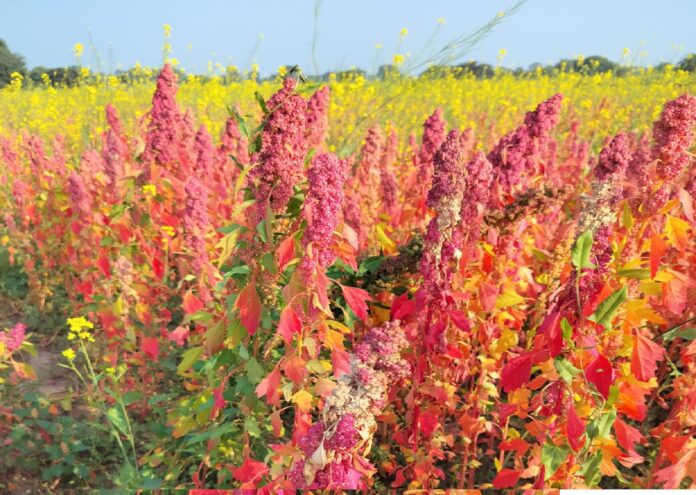
(Mohan Bhulani) Dehradun: Farmers in Uttarakhand are currently facing a double challenge. On one hand, climate change is continuously disrupting weather patterns, while on the other, rising cultivation costs and declining profits are making agriculture less attractive. Untimely rainfall, prolonged dry spells, hailstorms, and cloudburst incidents are no longer exceptions but are gradually becoming the new normal. The worst impact is being felt by farmers in the mountainous regions, where agriculture still largely depends on rainfall. At such a time, an important question arises: can Uttarakhand’s agriculture face future challenges by relying only on traditional crops?
The answer lies in adopting new thinking and modern agricultural practices. The need of the hour is to promote crops that provide better yields with less water, are rich in nutrition, and offer farmers better returns in the market. Quinoa is rapidly gaining global popularity because of these qualities and is emerging as a promising option for a mountainous state like Uttarakhand.
Originating from the Andes mountain region of South America, quinoa has established itself as a “superfood” worldwide. It is rich in high-quality protein, fiber, calcium, iron, magnesium, potassium, and all essential amino acids. This is why its demand continues to rise among health-conscious consumers. In India as well, quinoa is becoming increasingly popular among people adopting healthier lifestyles, from metropolitan cities to smaller towns. This growing demand has opened new market opportunities and better income prospects for farmers.
Its relevance is even greater in the context of Uttarakhand. Most of the state’s mountainous regions consist of small and fragmented landholdings. Irrigation facilities are limited, and agriculture is largely rain-fed. Under such conditions, crops requiring more water and higher investment increase the risks for farmers. In contrast, quinoa can produce good yields with relatively less water and can be successfully cultivated even in difficult geographical conditions. This characteristic makes it a sustainable option in the era of climate change.
This is the first government-level initiative to promote quinoa cultivation in Uttarakhand. Considering the potential of this superfood in the state, the department has decided to launch a pilot project. If the experiment proves successful, it will become a new and reliable source of income for hill farmers in the future. It will make agriculture in the mountainous regions more profitable and strengthen the economic condition of farmers. Based on the success of the project, there are plans to expand it to other districts in the future.
Dhiraj Garbyal, Secretary, Rural Development
Uttarakhand has long been making efforts to promote organic farming. In many of the state’s mountainous regions, the use of chemical fertilizers and pesticides is already limited. In such a scenario, if a high-value crop like quinoa is developed under organic cultivation and marketed nationally and internationally, it can become a new source of income for the state’s farmers. Establishing quinoa under the “Uttarakhand Organic” brand can give a new direction to the state’s agriculture.
However, merely promoting a new crop will not be sufficient. Farmers must be provided with quality seeds, scientific training, technical guidance, processing facilities, and direct access to markets. If farmers produce the crop but fail to receive a fair price, the initiative may not succeed. Therefore, strong coordination among the Agriculture Department, Horticulture Department, agricultural universities, Farmer Producer Organizations (FPOs), cooperative societies, and the private sector is essential. Establishing local processing units, promoting value addition, and connecting farmers with e-commerce platforms can play a significant role in increasing their income.
It is also important to understand that quinoa should not be viewed as a replacement for traditional millets such as mandua (finger millet), jhangora (barnyard millet), chaulai (amaranth), and ogal (buckwheat), but rather as a complementary crop. Uttarakhand’s traditional crops represent the state’s cultural heritage, nutritional strength, and biodiversity. Quinoa should be introduced alongside these crops through crop diversification so that farmers can reduce risks and develop new income sources. A diversified farming system will prove to be the strongest and most sustainable agricultural model for the future.
At a time when both the Central and State Governments are placing special emphasis on promoting Shree Anna (millets) and climate-resilient agriculture, Uttarakhand has an opportunity to make high-value crops like quinoa an important part of its agricultural policy. Agricultural research institutions must focus on developing improved varieties suited to the state’s local climate, while the government must strengthen farmers’ confidence through seed support, training, crop insurance, and marketing-related schemes.
Today, Uttarakhand’s biggest challenge is not merely to increase agricultural production but to make farming profitable and attractive for the younger generation. Only when agriculture becomes a source of respectable income will migration from villages decline and the hill economy become stronger. Quinoa can prove to be an effective step in this direction, provided it is supported by a visionary policy, a scientific approach, and a strong market ecosystem.
In the era of climate change, the wisest approach is to move agriculture forward by balancing tradition and innovation. For centuries, the land of Uttarakhand has sustained life despite difficult conditions. Now is the time for this land to present a new model of climate-resilient, nutritious, and high-value agriculture. Quinoa is not merely a new crop; it represents the agriculture of the future—one that has the potential to simultaneously protect the environment, improve farmers’ prosperity, and ensure better nutrition for society.