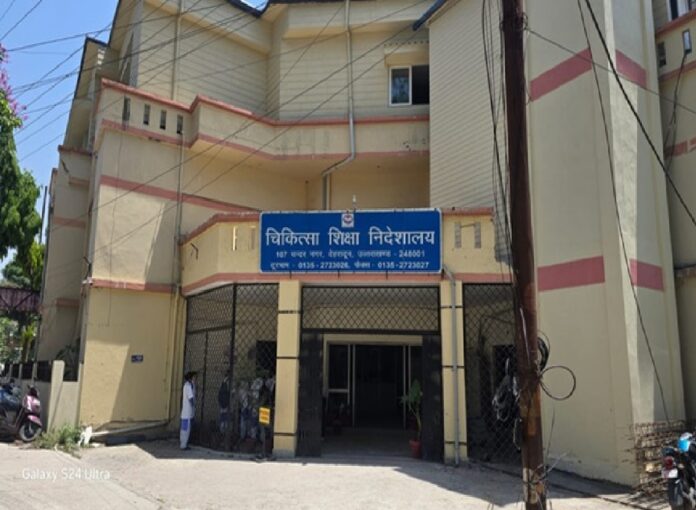
Dehradun: A serious administrative lapse has come to light in Uttarakhand’s Medical Education Department, where a fake government order (GO) was used to extend “equal pay for equal work” benefits, including minimum wage provisions, to contractual employees at the Medical Education Directorate. The discovery of the forged document has caused significant alarm within the department, prompting urgent internal deliberations and an ongoing inquiry into how the fake order was prepared, circulated, and acted upon without proper verification.
According to sources, the spurious government order listed the names of Deepesh Kumar Singh as Secretary and Abhilekh Kumar Shrivastava as Under Secretary. Preliminary investigations have revealed that these officers were not holding the respective positions in the government at the time the document was issued. Adding to the suspicions, the order lacked any specific reference to a section or division of the Health Department, a standard requirement for such official communications.
The matter surfaced when the Directorate issued instructions to implement the benefits for contractual (upnal) staff based on the fake GO. The instructions were particularly directed towards Doon Medical College, where 109 contractual employees were set to receive the financial benefits. However, timely doubts raised by alert officials at the college level halted the process before full disbursement could occur. Had the implementation proceeded unchecked, it could have led to substantial financial implications across multiple institutions under the department.
Sources indicate that each affected employee stood to receive an average additional payment of around ₹20,000. With dozens of employees involved at Doon Medical College alone, and the possibility of similar orders reaching other institutions, the total unwarranted payout could have been significant. This has raised serious questions about accountability: who will bear responsibility for the lapse, and how will any disbursed funds be recovered?
Lack of Verification
One of the most troubling aspects of the case is the apparent absence of due diligence. Departmental sources revealed that the Directorate proceeded with the order without independently verifying its authenticity. The fake GO was treated as legitimate, leading to formal instructions issued by the Director of Medical Education, Dr. Ajay Kumar Arya, for compliance at Doon Medical College. It was only through the vigilance of some officers that the irregularities were flagged, preventing what could have become a larger financial scandal.
Investigations are now focused on several critical questions: Who prepared the fake government order? How did it reach the Directorate and other offices? Why was it not subjected to standard authentication protocols? Officials are also examining whether similar fake orders may have been circulated to other departments, potentially creating a wider ripple effect.
The “equal pay for equal work” principle is a sensitive and legally significant issue in government employment, especially concerning contractual staff who often demand parity with regular employees. Implementing such benefits requires careful scrutiny, proper financial approvals, and alignment with state government policies. Bypassing these safeguards through a forged document has exposed vulnerabilities in the administrative processes of the Medical Education Department.
Potential Ramifications and Future Course
The exposure of the fake GO has triggered intense discussions at the departmental level. Senior officials are assessing the extent of the lapse and deliberating on corrective measures. There is growing expectation that strict action will be taken against those responsible for creating and circulating the fraudulent document, as well as any officials who failed to verify it before acting on it. Legal proceedings are likely under consideration to deter similar attempts in the future.
This incident also highlights broader concerns regarding document security and internal controls within Uttarakhand’s government departments. In an era of digital governance, the ease with which a fake order could influence administrative decisions points to gaps that need immediate attention. Strengthening verification mechanisms, perhaps through digital signatures, blockchain-based tracking, or mandatory cross-checks with issuing authorities, could help prevent recurrence.
For the contractual employees at Doon Medical College and elsewhere, the episode has created uncertainty. While their demand for fair wages is legitimate, this controversy may delay genuine efforts to address their concerns through proper channels. The state government will need to balance fiscal responsibility with employee welfare as the investigation progresses. As the probe continues, all eyes are on the Medical Education Department and higher authorities in the Uttarakhand government. The case serves as a reminder of the importance of vigilance, transparency, and accountability in public administration. Any leniency in handling such matters could erode public trust and set dangerous precedents.