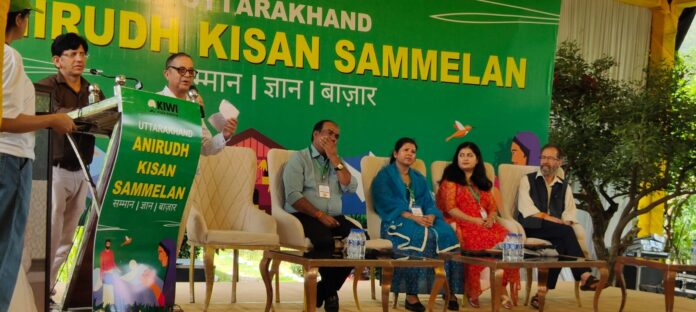
Vikash Nagar: Uttarakhand’s hill agricultural system, which forms the livelihood base for nearly 80 percent of the state’s rural population, is grappling with challenges such as climate change, small and fragmented landholdings, declining soil fertility, and lack of market access. Against this backdrop, the two-day “Uttarakhand Aniruddha Kisan Sammelan,” held at Aniruddha Ashram in Vikasnagar, provided farmers a strong platform to connect with knowledge, dignity, and markets. Organized by Kiwi Kisan Window (KIWI), the conference saw active participation from more than 500 farmers, with 24 progressive farmers honored during the event.
The conference was held in memory of the late Aniruddha Kumar, who made notable contributions to promoting cash crops in the Jaunsar-Bawar region and protecting farmers’ interests. Farmer leaders still remember his struggle against the VAT law in 2005. The theme of the conference, “Knowledge, Dignity, and Market,” proved to be an important step toward making Uttarakhand’s agriculture modern, profitable, and self-reliant.
The event was organized by KIWI co-founders Abhinav Ahluwalia and Nupur, in collaboration with the family of the late Aniruddha Kumar. KIWI works to provide farmers in the Himalayan states with awareness, modern technology, financial access, and better markets, with a farmer-first approach focused on connecting rural farmers—especially women farmers—to national and global platforms.
Agriculture in Uttarakhand faces significant challenges, with limited cultivable land and most of it in mountainous terrain. According to agricultural statistics, production of wheat, rice, potatoes, and pulses in the state has shown fluctuations. In 2025 data, wheat production increased (to about 9.39 lakh metric tonnes), while rice and potato output declined. Climate change has led to irregular rainfall, drought, and increased pest attacks, disproportionately affecting small and marginal farmers. The conference aimed to offer practical solutions to these issues.
The event opened with tributes to the late Aniruddha Kumar. Chief guest and Cabinet minister Khajan Das said that farmers’ economic prosperity is among the government’s top priorities, and that delivering modern technology, better marketing, and government schemes to the grassroots level is essential, adding that such platforms strengthen dialogue between farmers and experts.
Guest of honor and Vikasnagar MLA Munna Singh Chauhan emphasized that Uttarakhand’s real strength lies in its villages and farmers, stating that making farming profitable requires new technologies, processing, branding, and market linkages, and that Aniruddha Kumar’s struggle remains an inspiration for future generations.
The conference honored 24 progressive farmers with “Kisan Samman” awards. Organizers emphasized that true societal respect should go to farmers whose hard work strengthens the nation’s food system. Women farmers play a particularly notable role in Uttarakhand, contributing an estimated 70-90 percent of agricultural and livestock work in the state, yet they continue to face challenges in land ownership, technical training, and access to financial resources.
Experts from the State Bank of India, Uttarakhand Gramin Bank, NABARD, the Krishi Vigyan Kendra, and the animal husbandry department provided detailed information on Kisan Credit Cards (KCC), agricultural loans, crop insurance, subsidy schemes, and digital banking. Government schemes such as PM-KISAN, the Agriculture Infrastructure Fund, and NABARD initiatives are proving helpful in doubling farmers’ income. Experts noted that microfinance and Self-Help Groups (SHGs) are crucial for small farmers.
Women representatives, agricultural officials, and academics discussed how Uttarakhand’s women are leading in natural farming, horticulture, and organic production. Speakers said that providing women with training, credit, and market linkages can strengthen the rural economy, citing women-centered initiatives such as mushroom cultivation, floriculture, and herbal processing as successful examples in the Himalayan region.
The conference venue featured 17 stalls displaying traditional handicrafts, agricultural drones, organic products, modern equipment, and innovations. Farmers learned about drone-based spraying, smart irrigation, and the e-NAM platform.
In an “open mic” session, six progressive farmers shared their experiences related to natural farming, apple-kinnow horticulture, marketing models, and technical innovation. One farmer noted that natural farming had reduced input costs and improved soil health—an exchange expected to foster continued peer learning among farmers.
Agriculture makes a significant contribution to Uttarakhand’s GSDP, though productivity remains a challenge. The state is well-suited for organic farming, off-season vegetables, beekeeping, and herbal production. Central and state government schemes such as the National Natural Farming Mission, PMKSY, and the Horticulture Mission are promoting these opportunities, with climate-smart agriculture, value addition, and direct market linkages (the FPO model) seen as key to the future.
In the closing session, KIWI announced future plans including regular training camps, digital platforms, and market connectivity. The conference delivered a clear message: when farmers, scientists, banks, government, and markets work together, farming can become profitable and self-reliant.
This conference was more than just an event—it stands as a symbol of new hope for Uttarakhand’s farming community. If such efforts continue, hill agriculture can not only become self-reliant but also attract the younger generation toward farming. Aniruddha Kumar’s dream of respected and prosperous farmers is now on its way to being realized through collective effort.