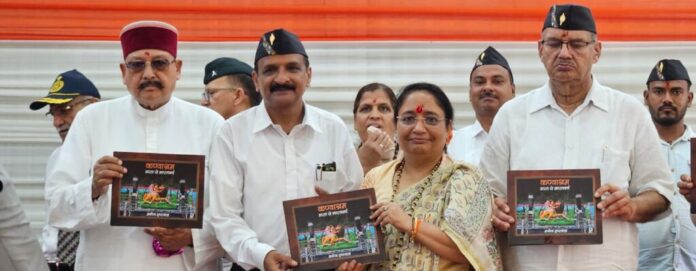
Kotdwar (Mohan Bhulani): In Kotdwar, a grand release of senior journalist and author Manoj Ishtwal’s coffee table book ‘Kanvashram’ was held. At a military-style ceremony, several dignitaries jointly released the book, including Uttarakhand Assembly Speaker Ritu Bhushan Khanduri, Tourism Minister Satpal Maharaj, Minister for Soldier Welfare Ganesh Joshi, Mayor Shailendra Rawat, and Lieutenant (Retd) General J.S. Negi.
The book is not merely a literary work but the result of years of deep research. Author Manoj Ishtwal has brought the legendary saga of Kanvashram to life through ancient texts, archaeological evidence, folk tales, and treks he personally undertook to the site. With attractive illustrations and detailed descriptions, the book aims to connect the younger generation with their cultural roots.
Kanvashram
Kanvashram is located about 14-16 kilometers from Kotdwar on the banks of the Malini (Malan) river. The site is famous as the place of penance (tapobhoomi) of the sage Kanva, where King Dushyant and Shakuntala’s love story took place, and where their son, the emperor Bharat, was born. It finds mention in the Mahabharata, Skanda Purana, Kalidasa’s Abhijnanashakuntalam, and other ancient texts.
According to the legend, Indra sent the celestial nymph Menaka to break sage Vishwamitra’s penance. The child born of their union, Shakuntala, was left behind by Menaka. Sage Kanva raised the infant in the ashram after she was found protected by “shakunt” birds. Dushyant married Shakuntala here during a hunting expedition (a Gandharva marriage). Their son Bharat went on to establish a vast empire, after whom the country came to be called ‘Bharatvarsha.’
According to historical evidence, Kanvashram is believed to be around 3,500-5,500 years old. It was a major center of Vedic learning, where thousands of students studied the Vedas, Vedangas, and spiritual knowledge. The ashram, situated on the banks of the Malini river, is also mentioned in Megasthenes’ ‘Indica’ (the Greek ambassador to Chandragupta Maurya’s court). British archaeologist Sir Alexander Cunningham confirmed its existence in 1865.
In the 12th century, Muslim invaders (Ghori, Iltutmish) destroyed this region along with Haridwar, damaging the physical remains of the ashram. Nevertheless, in 1956, then Uttar Pradesh Chief Minister Sampurnanand (on the directive of Pandit Nehru) laid the foundation stone of a memorial here. Today, the Basant Panchami fair is held here, drawing thousands of devotees. Archaeological Survey teams also periodically carry out excavations at the site.
Tourism Minister, Satpal Maharaj called the book a milestone. He said, “This book is not just a research work but will prove to be a milestone in bringing forward the country’s glorious history. The history of Kanvashram is directly linked to the identity of Bharatvarsha. Manoj Ishtwal’s coffee table book is not just for display but also for preservation. Kanvashram is a heritage not only of Uttarakhand but of the entire country. The Tourism Department is committed to developing Kanvashram as a global cultural tourism circuit based on the evidence presented in this book. Through this book, the younger generation will get an opportunity to understand their roots.”
Assembly Speaker, Ritu khanduri Bhushan openly praised the author’s research work at the release of Manoj Ishtwal’s book ‘Kanvashram.’ She said, “This glorious history of Kotdwar and Kanvashram makes every resident of Uttarakhand proud. Through years of deep research, Manoj Ishtwal has presented this mythological site to the new generation in a vivid form. This book is not merely a book but a document of our cultural heritage. Every possible effort will be made to develop Kanvashram and revive its historical form. The state government is continuously working in this direction and will take concrete steps to develop Kanvashram as a tourism and cultural center.”
Agriculture Minister, Ganesh Joshi said, “Through this book, Manoj Ishtwal has not merely written the story of an ashram, but has brought to life the cultural and mythological heritage of the whole of Uttarakhand and India. Kanvashram is the birthplace of the emperor Bharat, after whom our country is called ‘Bharatvarsha.’ This book is both well-researched and beautifully prepared as an attractive coffee table book that will connect the younger generation to their roots. Our government is prioritizing the development of Kanvashram. This site will be further enhanced to promote tourism, cultural preservation, and agro-tourism. I wholeheartedly appreciate Manoj’s research efforts and wish that this book spreads the dignity of Kanvashram across the country and abroad.”
Lieutenant General J.S. Negi (Retd.) praised Manoj Ishtwal’s book ‘Kanvashram,’ calling it significant from both a military and cultural perspective. He said, “Kanvashram is not just a mythological and cultural heritage site but also a symbol of our national identity. Through this book, Manoj Ishtwal has presented the birthplace of the emperor Bharat to the new generation in a new light. This work, based on years of deep research and facts, is truly commendable. Such books not only preserve history but also strengthen the spirit of patriotism and cultural pride. The development and preservation of sites like Kanvashram is the responsibility of all of us.”
Other dignitaries also praised Manoj Ishtwal’s efforts. The dignity of the military ceremony made the event memorable.
The Author’s Research Journey
Manoj Ishtwal said, “I had been researching this for years. I trekked upstream along the Malini river and combed through ancient texts and folk tales. The book contains the complete distillation of these facts.” The book includes a detailed account of how Bharat’s story led to the naming of Bharatvarsha, along with images of the ashram and its mythological grandeur. It is both a decorative coffee table book and one meant for preservation.
Cultural Significance
Kanvashram is significant not only for its mythological importance but also from the perspective of tourism, education, and cultural preservation. Nestled in the lap of the Himalayas, with the cool flow of the Malini river and dense forests, the site is a symbol of peace. The government and local committees (such as the Kanvashram Development Committee) are working towards making it a national monument and developing it further.
Manoj Ishtwal’s book ‘Kanvashram’ will lend strength to such efforts. This outcome of decades of research is not just a literary contribution but also a medium of cultural awakening. It will remind the youth that India’s identity is not merely geographical, but a legacy like that of Bharat.