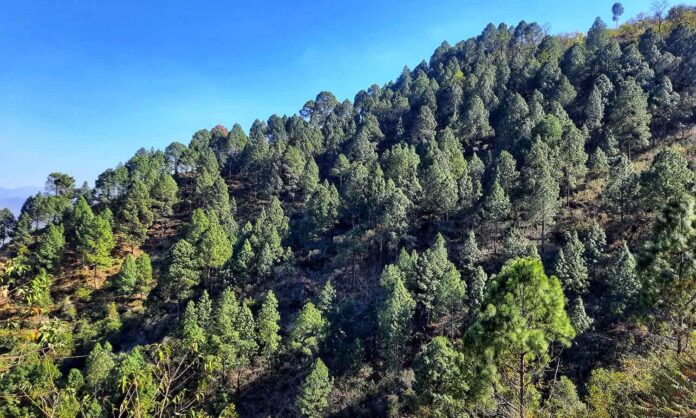
Ranikhet (Almora): Uttarakhand is set to take a pioneering step in forest conservation by establishing dedicated ‘Harela Van’ (Harela Forests) across the state. These mixed-species community forests will be developed on forest land with active public participation and nurtured for five years to ensure long-term survival and growth. For the first time, the Forest Department has formulated a five-year plan to create these model forests, aiming to reverse the trend of limited increase in forest cover despite large-scale plantation drives.
According to the Uttarakhand Forest Department, ‘Harela Van’ will be developed in approximately 900 forest sections (beats) across the state. Each forest will span 2.5 to 3 hectares or more. The initiative will cover 27 forest divisions and 162 ranges in both Kumaon and Garhwal regions. The primary goal is to ensure that planted saplings survive and mature into genuine forests, addressing the persistent challenge of low survival rates in traditional plantations.
Every year, the department plants over one crore saplings of various species, with special emphasis during the annual Harela festival. However, forest cover has not increased proportionately due to factors such as poor post-plantation care, grazing, fire incidents, and harsh climatic conditions. The ‘Harela Van’ model seeks to overcome these issues through sustained protection and community involvement.
In Ranikhet, the initiative has already begun. Forest Range Officer Tapas Mishra informed that six sections—Sauni Binsar, Billekh, Kalika, Majkhali, Ganiadyoli, and Chaubattia—are being developed as ‘Harela Van’. Work has started on a three-hectare site in Sauni Binsar, and a second similar-sized forest is under development in Ganiadyoli. With public participation, more than 500 saplings of various species have already been planted in Sauni Binsar.
A unique feature of these forests is the inclusion of not only traditional multipurpose trees such as banj (oak), deodar, kafal (box myrtle), and utis, but also fruit-bearing and flowering plants. This will enhance biodiversity, provide economic benefits to local communities through fruits and flowers, and create a more resilient ecosystem. The forests will be fenced and protected by the Forest Department for the first five years. During this period, children, parents, women, teachers, retired officials and employees, and general citizens will be encouraged to plant their favorite saplings, fostering a deep emotional and communal connection with nature.
The initiative carries a strong message of community ownership and collective responsibility. By involving diverse sections of society, the department aims to build long-lasting forests that can withstand environmental pressures and contribute to ecological balance.
Experts believe that mixed-species forests like these will be more fire-resistant, help prevent soil erosion, improve water retention, and support wildlife habitats. They will also enhance the scenic beauty of popular tourist destinations like Ranikhet, attracting more eco-tourism and generating local employment opportunities.
The ‘Harela Van’ project aligns with the spirit of the traditional Harela festival, celebrated every year in the Kumaon region to express gratitude to nature and promote conservation. The Uttarakhand government hopes that this participatory model will significantly increase the state’s forest cover, preserve biodiversity, and serve as an example for other regions facing similar challenges.
If successful, the initiative could transform thousands of hectares of degraded or vulnerable forest land into thriving green lungs for future generations. The Forest Department has called upon citizens to actively participate and make ‘Harela Van’ a people’s movement for a greener Uttarakhand.