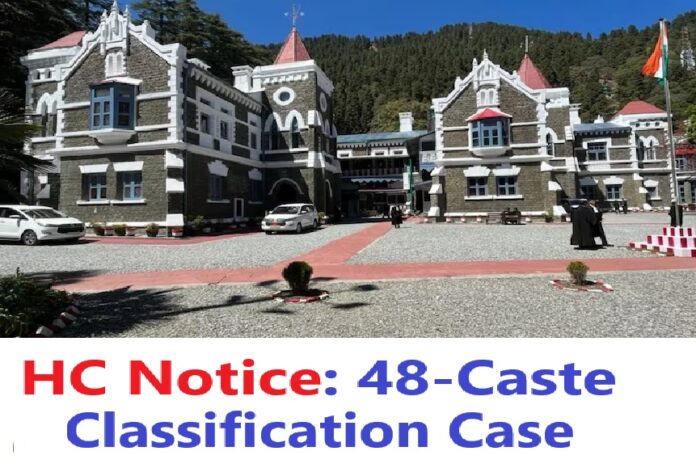
Nainital : In a significant development impacting Uttarakhand’s reservation framework and social justice policies, the Nainital High Court has issued notices to the Union and state governments, challenging the inclusion of 48 non-scheduled castes in the Scheduled Castes (SC) list through executive orders in 2013 and 2014. A division bench comprising Chief Justice G. Narendra and Justice Subhash Upadhyay, during a hearing on December 5, directed the Secretaries of the Ministry of Home Affairs, Ministry of Law and Justice, and Ministry of Social Justice and Empowerment, along with Uttarakhand’s Principal Secretary (Social Welfare), to file responses within four weeks. The next hearing is scheduled for January 6, 2026. The public interest litigation (PIL), filed by Haridwar resident Meenu, contends that these inclusions violate Article 341 of the Constitution, which vests exclusive authority in the President and Parliament to notify or amend the SC list. The petitioner has urged the court to restore constitutional propriety in the state.
This case has ignited fresh debate on the boundaries of state powers in affirmative action, potentially affecting thousands who have benefited from the expanded quotas. The PIL targets government orders issued by the then Principal Secretary (Social Welfare) in 2013-14, which added castes such as Koli, Gujjar, Bakarwal, Jatav, Pasi, Dhobi, Lohar, Nai, Kumhar, Teli, Badhai, Loniya, Dhangar, Jogi, Saini, Kashyap, Mallah, Kewat, Kumawat, Raikwar, Bareli, Garhwali, Kumaoni Brahmin, Rajput, Thakur, Jain, Sikh, Buddhist, Christian, and others to the SC roster. These amendments extended reservation benefits in government jobs, educational institutions, and welfare schemes to these groups, previously classified under Other Backward Classes (OBC) or general categories. Meenu argues that such unilateral state action amounts to overreach, diluting the SC list’s original intent to uplift historically oppressed communities. The petition further highlights the state’s failure to establish SC/ST special courts as mandated by a January 26, 2016, gazette notification, exacerbating delays in atrocity cases.
Constitutional experts view this as a test of federalism in reservation matters. Article 341 empowers the President to specify SCs via public notification, with Parliament holding amendment rights; states can only recommend changes. Senior advocate Dr. S.P. Sharma noted, “This isn’t unprecedented—high courts in Uttar Pradesh and Bihar have struck down similar state notifications. Uttarakhand, formed in 2000 from Uttar Pradesh, inherited a 66-caste SC list, but the 2013-14 expansions ballooned it to 114 without central nod. If the court rules against the state, it could upend futures for around 200,000 beneficiaries.” Sharma warns of potential social unrest, as the orders were framed on local surveys deeming these castes socio-economically disadvantaged. The Centre had objected in 2016, clarifying that sub-classifications or additions require parliamentary approval, rendering state-level tweaks invalid.
Uttarakhand’s SC population stands at about 18% of its 1.1 crore residents, making reservation a politically charged issue. The expansions were introduced by the BJP government in 2014 to address perceived inequities in hill and plain regions, where migration and economic disparities vary. Proponents argue it aligns with the Mandal Commission’s spirit of inclusive backwardness, but critics decry it as vote-bank politics. The PIL claims it infringes on OBC and general category rights, squeezing merit-based opportunities in a state already grappling with unemployment. Nationally, similar demands simmer in Maharashtra and Telangana, where sub-categorization within SC/ST quotas is under judicial scrutiny post the 2024 Supreme Court verdict allowing it in some cases.
Politically, the ruling BJP faces heat. The 2014 orders were a cornerstone of its social outreach, but opposition Congress has labeled them “unconstitutional,” threatening protests. Senior Congress leader Harish Rawat stated, “The government is mocking the Constitution under the guise of reservation. The court’s intervention is welcome, but justice must reach affected families—perhaps through a review mechanism.” A state spokesperson countered, “We will robustly defend our position in court and expedite central clearances.” The controversy echoes the 1992 Indira Sawhney case, where the Supreme Court upheld 27% OBC quotas but barred SC/ST dilution, introducing the ‘creamy layer’ exclusion.
A key grievance in the PIL is the non-establishment of SC/ST special courts under Article 338, aimed at swift trials for atrocities. Despite the 2016 mandate, Uttarakhand lacks dedicated infrastructure, forcing victims into overburdened district courts—delays averaging 3-5 years. The National Commission for Scheduled Castes issued a 2024 warning to the state for non-compliance, citing rising untouchability incidents in rural hills. If the high court mandates action, it could spur nationwide reforms, aligning with the Atrocities Act’s 2023 amendments for faster convictions.
This litigation transcends legality, probing social equity’s core. Dr. B.R. Ambedkar envisioned reservations as a temporary scaffold for equality, not perpetual fragmentation. In Uttarakhand’s diverse tapestry—blending Garhwali and Kumaoni cultures with tribal influences—the ruling could reshape community harmony. Activist Meera Bedi opined, “Caste identification for benefits must stem from scientific censuses, not political expediency. The court’s verdict will set a precedent for evidence-based affirmative action.”
As responses pour in ahead of January 6, the Centre and state may seek time extensions or interim stays. A adverse ruling could necessitate rehabilitation for beneficiaries, perhaps via OBC reclassification. Ultimately, this PIL seeks to realign Uttarakhand with constitutional ethos, compelling a nuanced review of reservation paradigms. Stakeholders hope for a balanced outcome safeguarding vulnerabilities without eroding federal trust.