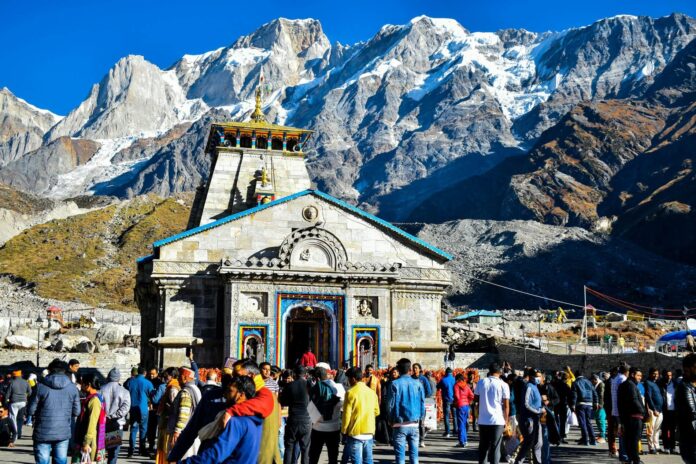
Dehradun: In a groundbreaking initiative blending innovation, sustainability, and pilgrim comfort, Uttarakhand Chief Minister Pushkar Singh Dhami has announced that devotees at the sacred Kedarnath Dham will soon enjoy round-the-clock hot water supply at high altitudes — a facility powered entirely by eco-friendly biomass geysers using locally sourced pine needles and mule dung. This pioneering project, claimed to be the first of its kind in India, marks a major step towards making the Char Dham Yatra safer, more comfortable, and environmentally responsible.
The innovative biomass-powered hot water system will be installed at two critical locations — GMVN Kedarnath and Lincholi — well ahead of the 2026 Char Dham Yatra season. These geysers will run on pellets made from “pirul” (dry pine needles) and mule dung, two abundant local resources that have long posed environmental challenges in the Himalayan region.
Dual Environmental Victory: Waste to Wealth
This unique initiative cleverly addresses two pressing problems simultaneously. The Kedarnath yatra route sees thousands of mules transporting pilgrims and goods daily, resulting in massive accumulation of dung that creates sanitation hazards and unpleasant conditions. At the same time, pine needles, which carpet forest floors every year, are highly inflammable and contribute significantly to forest fires in Uttarakhand.
By converting these materials into biomass pellets, the government is turning waste into a valuable renewable energy source. The project not only provides comfort to lakhs of pilgrims braving freezing temperatures at over 3,500 meters but also promotes a circular economy in the fragile Himalayan ecosystem.
As part of a pilot project, roadside dhabas (small eateries) along the yatra route will also receive biomass-powered stoves. These stoves will prove especially useful during power outages and energy shortages common in remote hilly areas. If successful, the government plans to scale up distribution of such stoves across the state, creating new income opportunities for local pellet producers while reducing dependence on LPG and firewood.
Chief Minister Pushkar Singh Dhami, while chairing a high-level meeting at his residence with senior officials from Urban Development, Tourism, and Forest Departments, emphasized that these measures reflect the state’s commitment to sustainable development. “We want to ensure that pilgrims receive modern facilities without harming the environment,” he said.
To transform the Char Dham Yatra into a spiritually enriching, safe, clean, and economically beneficial experience for everyone. We invite all stakeholders, local communities, and pilgrims to join hands with us in making this vision a reality. Uttarakhand is ready to welcome millions of devotees in 2026 with open arms, better facilities, and a stronger commitment towards preserving our fragile Himalayan environment.”
— Dhiraj Singh Garbyal, Tourism Secretary, Uttarakhand
Massive Waste Management Infrastructure Deployed
The state has significantly strengthened its solid waste management machinery for the yatra. Thirty urban local bodies along the pilgrimage routes have been reinforced with additional resources. A large workforce of sanitation workers, including specially designated “environmental friends,” has been deployed to maintain cleanliness at roads, markets, ghats, and public spaces round the clock.
Under the comprehensive solid waste management plan, the government has already operationalized:
- 37 Material Recovery Facilities (MRF) centers
- 299 compost pits
- 38 plastic compactors and baling machines
- 266 waste transport vehicles
These facilities will enable scientific segregation, processing, and disposal of waste generated during the peak yatra season when millions of devotees visit the shrines.
Preserving the Sanctity of the Himalayas
The Char Dham Yatra is not only a deeply spiritual journey for millions of Hindus but also a vital economic lifeline for Uttarakhand’s mountain communities. However, in recent years, rapid growth in pilgrim numbers has put immense pressure on the fragile Himalayan ecology — from waste accumulation to deforestation and water pollution.
The “Green and Clean Yatra” campaign, now significantly strengthened under CM Dhami’s leadership, aims to balance devotion with conservation. By promoting biomass energy, eliminating single-use plastics, and enhancing waste management, the state government hopes to set a global example of responsible religious tourism.
Tourism experts believe these initiatives will improve the overall pilgrim experience. Hot water availability at Kedarnath will particularly benefit elderly devotees and those with health conditions, while reliable clean drinking water facilities will reduce health risks associated with contaminated sources.
Broader Impact on Local Economy and Environment
The biomass project is expected to generate new employment opportunities in pellet manufacturing, stove distribution, and maintenance. Local youth and self-help groups are likely to be involved in collection of pine needles and processing of mule dung, providing supplementary income during both yatra and off seasons.
Environmentally, the initiative could significantly reduce forest fire incidents in Uttarakhand, a state that has suffered massive losses due to pine needle fires in the past. Proper management of mule waste will also improve hygiene along the 16-km trek to Kedarnath, making the journey more pleasant.
The plastic-free drive aligns with national missions like Swachh Bharat Abhiyan and aligns with Prime Minister Narendra Modi’s vision of sustainable development. Uttarakhand, being home to some of India’s most sacred and ecologically sensitive sites, is uniquely positioned to lead this transformation.
Implementation Timeline and Monitoring
Officials have been directed to complete all installations and pilot testing before the Char Dham Yatra 2026 begins in full swing. Regular review meetings will be held to monitor progress, with strict accountability for departments involved.
Senior officers present in the meeting assured the Chief Minister that all preparations are being made on a war footing. Integration of technology — from drone surveillance to centralized command centers — demonstrates the government’s modern approach to traditional pilgrimage management.
As Uttarakhand prepares to welcome millions of devotees in 2026, these innovative steps signal a new era where faith, comfort, and environmental stewardship go hand in hand. The combination of hot water at Kedarnath powered by local waste and a comprehensive plastic-free strategy could redefine how India manages its major pilgrimage destinations.
Chief Minister Dhami’s vision positions Uttarakhand as a pioneer in eco-friendly religious tourism — ensuring that future generations can continue to experience the divine beauty of the Char Dham shrines in a clean and sustainable Himalayan environment.