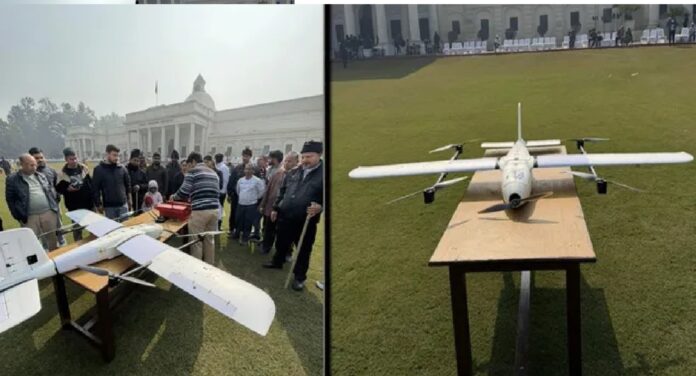
IIT Roorkee Develops Revolutionary Drone for Low-Cost Artificial Rain and Snowfall: A Game-Changer for Drought, Forest Fires, and Himalayan Water Security
Roorkee: The Indian Institute of Technology (IIT) Roorkee has achieved a major breakthrough in climate engineering by successfully testing an advanced drone-based system capable of inducing artificial rainfall and snowfall at significantly lower costs. Weighing just 11 kilograms, this innovative drone can ascend to approximately 4 kilometers above ground level, enabling precise targeting of clouds in challenging terrains.
Led by Professor Abhayanand Singh Maurya (A.S. Maurya) from the Department of Earth Sciences, the project was conducted in collaboration with industry partner AccelESG. The drone integrates cutting-edge AI-driven weather analysis, autonomous flight systems, and high-precision seeding mechanisms to disperse agents that enhance precipitation from suitable clouds.
Professor Maurya emphasized that India is increasingly viewing cloud seeding (a form of geo-engineering) as a strategic tool to combat rising challenges such as erratic and uneven rainfall patterns, prolonged droughts, declining groundwater levels, and the growing frequency of drought-like conditions exacerbated by climate change. In many regions, intense short-duration heavy rains contrast sharply with prolonged dry spells in others, severely impacting agriculture, drinking water security, and hydropower generation.
Cloud seeding aims to optimize the use of existing atmospheric moisture by encouraging rain from appropriate clouds, thereby improving the spatial and temporal distribution of precipitation. Globally, aircraft-based cloud seeding remains the most established method, as it allows accurate delivery of seeding agents (such as silver iodide, sodium chloride, or potassium chloride) at optimal altitudes within targeted cloud systems.
However, rapid advancements in high-quality drones, autonomous navigation, and AI-powered meteorological forecasting present a promising complementary approach. According to Professor Maurya, these technologies offer substantial advantages in terms of cost-efficiency, operational flexibility, rapid deployment, and localized control — particularly for experimental, pilot-scale missions, and regions with difficult access like the Himalayas.
The 11-kg drone has undergone successful trials, demonstrating its potential to generate artificial rain and snowfall in mountainous areas at a fraction of the cost of traditional aircraft operations. In Uttarakhand and similar Himalayan states, reduced natural snowfall due to warming trends affects tourism, river recharge, and water availability. Artificial snowfall could help mitigate these impacts.
Additionally, low soil moisture from deficient rainfall heightens the risk of forest fires, a recurring problem in India’s woodlands. By inducing targeted artificial rain, the drone can restore moisture in soil and vegetation, thereby reducing fire incidents and protecting ecosystems, biodiversity, and carbon sinks.
Professor Maurya noted that the team is now engaging with government authorities to explore real-world implementation of this technology. If scaled up nationally, it could provide an affordable, indigenous solution to water scarcity in drought-prone areas, enhance agricultural productivity, and support disaster risk reduction.
India has a long history with cloud seeding experiments, but drone-based efforts have gained momentum recently. In August 2025, Rajasthan launched the country’s first drone-AI-powered cloud seeding pilot near Ramgarh Dam (also known as Jamwaramgarh Dam) to revive the drying lake and address acute water shortages. Using 60 specialized drones equipped with AI platform ‘Hydro Trace’ for real-time cloud identification via satellite and sensor data, the operation dispersed sodium chloride (NaCl) particles, successfully triggering 0.8 mm of rainfall in just 30 minutes — marking a historic milestone in low-cost, precise weather modification.
Similarly, in October 2025, Delhi — in collaboration with IIT Kanpur — conducted aircraft-based cloud seeding trials using silver iodide flares to combat severe winter pollution through induced rainfall. While some attempts faced challenges due to insufficient atmospheric moisture, preliminary data indicated increased precipitation on seeded days, highlighting the technology’s potential under ideal conditions.
Globally, the United Arab Emirates leads in drone-based cloud seeding, employing electric-charge or laser-equipped drones to boost rainfall in arid regions. China has also reported large-scale successes, including drone operations in Xinjiang that generated millions of gallons of additional precipitation.
Experts estimate that with proper cloud selection and AI-enhanced forecasting, cloud seeding success rates can range from 10-35%, depending on meteorological conditions. IIT Roorkee’s drone represents a significant step toward making this technology more accessible, scalable, and tailored to India’s diverse geography — from arid plains to snow-dependent Himalayas.
This indigenous innovation underscores India’s growing prowess in addressing climate challenges through homegrown science and technology. By complementing conventional methods, drone-based systems like this could play a pivotal role in ensuring water security, safeguarding agriculture, preventing forest fires, and building resilience against climate variability.