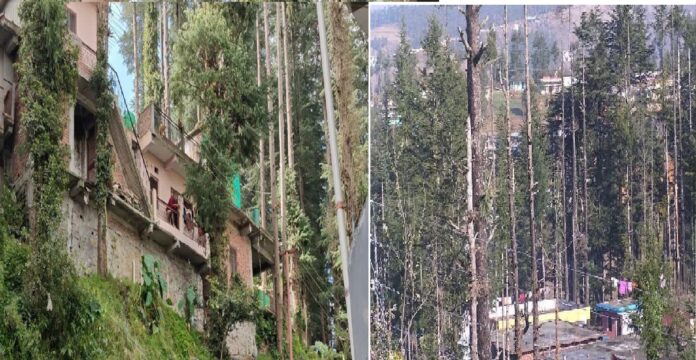
Champawat: The picturesque Lohaghat region in Uttarakhand’s Champawat district, enveloped in lush deodar forests, is facing a growing environmental crisis. Over the years, the unchecked rise of concrete structures, encroachments, and illegal tree felling has put these majestic trees at severe risk. Images of drying deodar trees going viral on social media have finally spurred the district administration and forest department into action. Under the directives of District Magistrate Manish Kumar, the Lohaghat forest division has initiated treatment for affected trees and registered a case under the Forest Act against unidentified individuals responsible for the damage. Local residents are expressing deep concern over the escalating threat to these vital trees.
In the Lohaghat Municipal Council area, a sinister plot to dry out hundreds of rare and historic deodar trees by pouring chemicals—allegedly to facilitate encroachments—has come to light, deepening the crisis. The issue gained traction after visuals spread rapidly on social media, prompting immediate intervention from authorities. The forest department swung into action, launching remedial measures to save the withering trees. A team led by Sub-Divisional Forest Officer Lohaghat, Sunil Kumar, has conducted gardening and specialized treatments on over a dozen healthy deodar trees to prevent further drying.
Additionally, a case has been filed against unknown perpetrators under the Forest Conservation Act. However, the protection of deodar trees in Lohaghat has long been mired in administrative ambiguity. Much of the land falls under the nazool category, traditionally overseen by the revenue department, while responsibility for tree safeguarding remains unclear between the municipal council and the forest department. The District Magistrate has proposed assigning area-specific departmental duties in January-February, but implementing this on the ground is seen as practically challenging.
Senior citizen and veteran journalist from Lohaghat, Ganesh Pandey, highlighted the alarming decline, stating that over 12,000 deodar trees have vanished from the urban area in recent decades due to encroachments and other factors. Recalling historical efforts, he noted that in 1985—when Champawat was part of Pithoragarh district—environment enthusiast District Magistrate Vijendra Pal had numbered and documented nearly 15,000 deodar trees in Lohaghat town. By 2013, a count conducted under then-DM Chaudhary revealed the number had dwindled to around 12,000. Since then, illegal felling and encroachments have persisted unchecked, with axes being wielded on deodars even in broad daylight. While the forest department has imposed fines, no in-depth investigations or permanent solutions have addressed the root causes or identified those enabling such activities.
Pandey advocated for robust conservation measures, including the installation of CCTV cameras in deodar-covered areas, with monitoring directly handled by the local police station. He suggested entrusting full security of the deodar forest zones to the forest department, while mandating regular joint patrols by the municipal council and forest officials. Furthermore, he proposed involving nearby residents by assigning them written responsibilities for tree protection, fostering a sense of ownership to treat these trees as a shared heritage.
The deodar forests hold immense appeal for tourists and pilgrims visiting from major cities like Delhi, Kolkata, and Mumbai, who flock to sites such as the Mayavati Ashram and Reetha Sahib religious area to admire these iconic trees. As the crisis unfolds, stakeholders urge swift and collaborative action to preserve this natural treasure before it’s too late.