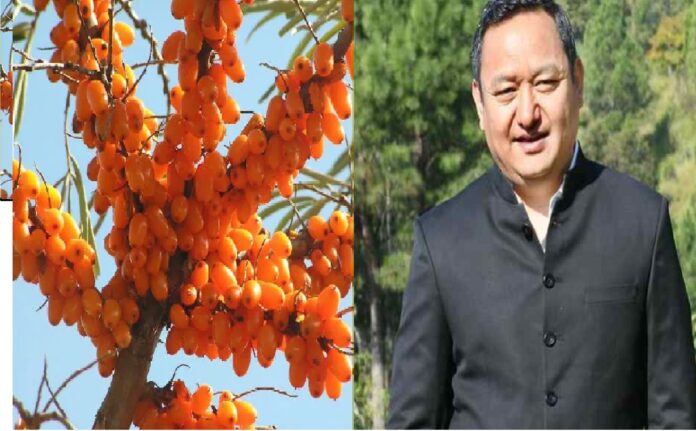
Mohan Bhulani (Dehradun): Wild fruits growing in Uttarakhand’s forests have long been a major source of nutrition and health for local communities. These fruits, used in traditional medicine and Ayurveda, are considered rich in antioxidants, vitamins, and medicinal properties. Now, the government is taking concrete steps toward the scientific utilization and commercial exploitation of these wild resources. The objective is to strengthen rural livelihoods, add value to forest products, and connect them to national and international markets. This initiative is expected to give new momentum to the forest-based economy.
The state government is planning large-scale production of Sea Buckthorn. This plant, known scientifically as Hippophae salicifolia, grows naturally in Himalayan regions and can become a significant means of bolstering farmers’ economies. It is being promoted particularly in the Darma and Byas valleys of Pithoragarh district. Not only does it aid in environmental conservation, but it also provides economic benefits due to the growing demand in health and beauty products.
What is Sea Buckthorn and Why is it Important? Sea Buckthorn is a shrubby plant that grows in cold desert regions. It is found at altitudes of 1,500 to 4,000 meters and is rich in Vitamin C—one fruit contains 12 times more Vitamin C than an orange. Additionally, it is abundant in Vitamin E, omega fatty acids, and antioxidants. Traditionally, Himalayan communities use it as medicine for skin diseases, digestive issues, and fatigue relief. In modern times, it is used in juices, oils, cosmetics, and supplements. Its demand is increasing in the global market, especially in Europe and America, where it is called a ‘superfood.’
In Uttarakhand, Sea Buckthorn is known as ‘Badri Berry’ or ‘Chuk.’ It grows wildly in the state’s mountainous districts and helps prevent soil erosion. However, there are challenges for large-scale cultivation, such as harsh climate and lack of accessibility. Research indicates that if managed properly, it can benefit both the environment and economy, but excessive exploitation could impact biodiversity.
Uttarakhand Government’s Plans and Initiatives The Uttarakhand government has launched several schemes to promote Sea Buckthorn. The Aroma Revolution Policy (2026-36), launched in 2025, aims to boost the cultivation of aromatic and medicinal plants in the state, generating revenue of Rs 1,200 crore over 10 years. Under this policy, seven aroma valleys and five satellite centers will be established. Farmers will receive 80% subsidy for up to 1 hectare and 50% thereafter. Recognizing Sea Buckthorn as a superfood, the central government has also approved Uttarakhand’s proposals.
The Darma and Byas valleys in Pithoragarh district are the focus of this scheme. These valleys are located in high Himalayan areas where Sea Buckthorn is abundant naturally. The local Bhotia community has traditionally used its fruits. The government has set up demo plots here, where cultivation is being done on 1-2 hectares. Farmers are being provided training, seeds, and market linkages. This will not only strengthen the local economy but also help curb migration. However, some experts believe that large-scale farming could affect the local ecology, so emphasis should be placed on sustainable development.
Availability of Sea Buckthorn in Uttarakhand’s Mountainous Districts Sea Buckthorn is mainly available in wild form in Uttarakhand’s mountainous districts. According to recent surveys and research, its total distribution area in the state is approximately 5,200 hectares. This data is based on natural demographic surveys and includes Uttarkashi, Rudraprayag, Chamoli, and Pithoragarh districts.
The detailed breakdown is as follows:
| District | Valley/Area | Estimated Area (Hectares) |
|---|---|---|
| Uttarkashi | Har-ki-Dun | 300 |
| Uttarkashi | Gangotri-Harsil | 800 |
| Uttarkashi | Yamunotri | 1000 |
| Rudraprayag | Kedar Valley | 300 |
| Chamoli | Mana-Badri Valley | 1200 |
| Chamoli | Niti Valley | 200 |
| Pithoragarh | Munsiyari Valley | 400 |
| Pithoragarh | Byas, Darma, and Chaudas Valleys | 1000 |
| Total | 5200 |
(This data is taken from the Phytotex Journal and the National Mission on Himalayan Studies.)
In Pithoragarh’s Darma and Byas valleys, Sea Buckthorn is available across about 1,000 hectares, found in villages like Milam, Rilkot, Martoli, etc. However, precise production figures are not available since most of it is wild. Estimated fruit production per hectare could be 2-5 tons, but it is lower in wild areas. In Ladakh, 500 tons are harvested annually from 11,000 hectares, leading to an estimate of 100-200 tons for Uttarakhand. Government reports mention that it is abundant in Chamoli’s Niti and Mana valleys, as well as Uttarkashi’s Gangotri area.
According to Dheeraj Garbyal, Secretary of the Rural Development Department... A work plan is being prepared under the Rural Enterprise Acceleration Growth (REAP) scheme to encourage Sea Buckthorn cultivation in mountainous districts. High Himalayan areas in Pithoragarh, Chamoli, Rudraprayag, Uttarkashi, and Tehri—where Sea Buckthorn is currently produced—will be identified. Thereafter, local people will be motivated and supported in a planned manner for cultivating this crop.
Economic and Environmental Benefits Sea Buckthorn can improve the economy of Himalayan farmers. From one hectare, 10-15 tons of fruit can be obtained, with a market price of Rs 100-200 per kg. It can be used to make juices, oils, and teas. The Bhotia community in Pithoragarh’s Milam has already been using it commercially. Environmentally, it binds the soil and aids in water conservation. However, climate change is affecting its availability. Experts suggest promoting cultivation organically.
Plans for large-scale production face challenges like lack of accessibility and market development. The government should establish processing units. Research shows that Uttarakhand has high biodiversity in Sea Buckthorn, but conservation is essential. In the future, it could contribute to the state’s GDP.