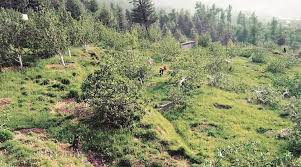
Haldwani: In a stern rebuke to the Uttarakhand government, the Supreme Court has expressed deep displeasure over rampant encroachments on forest land, directing authorities to reclaim all vacant plots while exempting only legitimate residential structures. With over 71% of its territory under forest cover, the Himalayan state faces a severe crisis: out of its total 5.348 million hectares, approximately 3.8 million hectares are forested, yet 11,900 hectares remain illegally occupied as of April 2023. The apex court’s order underscores the urgency of preserving the state’s fragile ecology amid growing urbanization and administrative lapses.
A bench led by Justice B.R. Gavai, hearing a petition on forest conservation, lambasted the state for failing to curb the “alarming” trend. “Encroachment on forest land is unacceptable and threatens biodiversity,” the court observed, mandating a comprehensive eviction drive excluding homes built for habitation. This directive stems from an affidavit filed by the Uttarakhand Forest Department before the National Green Tribunal (NGT), revealing that encroachments have surged by 2,400 hectares between 2019 and January 2025—despite the government’s claim of liberating 2,023 hectares in 2023 alone.
The scale of the problem is staggering. In a 2022 Lok Sabha response, Union Environment, Forest and Climate Change Minister Bhupendra Yadav disclosed that 10,649 hectares of forest land were encroached upon in Uttarakhand, placing it third among Himalayan states after Jammu & Kashmir and Himachal Pradesh. Contributing factors include delays in reclaiming land post-lease expiry, unchecked expansion of new settlements, and misuse by communities like Van Gujjars, who have converted grazing allotments into illegal farmlands. As of 2017, 31 forest divisions reported 9,506 hectares under occupation—a figure that has nearly doubled in eight years.
Encroachments have infiltrated even protected zones like Corbett and Rajaji Tiger Reserves, where not only has land been seized but also illegally transacted. Unauthorized religious structures have cropped up within these sanctuaries, exacerbating habitat loss for endangered species. Environmental activist Ajay Agarwal, who has long campaigned on the issue, hailed the verdict: “This is a wake-up call. The state’s green lung is choking under human greed, but enforcement must be transparent to avoid displacing vulnerable families.”
The Forest Department’s NGT submission paints a grim picture: despite anti-encroachment drives, new occupations continue unabated, driven by population pressures and weak monitoring. In a recent operation, the department cleared illegal structures in Puchdi village near Ramnagar, freeing prime tiger habitat. Uttarakhand’s Chief Wildlife Warden, D.K. Singh, acknowledged the challenges: “Administrative hurdles and legal battles post-lease often delay reclamation. We’re ramping up surveys and patrols, but community relocation plans are essential to prevent backlash.”
Experts attribute the crisis to Uttarakhand’s unique geography—steep hills and valleys make patrolling arduous, while rapid urbanization in districts like Dehradun and Haridwar fuels land hunger. A 2024 Wildlife Institute of India (WII) study warns that unchecked encroachments could reduce the state’s forest cover by another 0.5% annually, worsening landslides and floods in this disaster-prone region. The NGT has now ordered the state to submit a detailed compliance report within three months, including timelines for evictions and penalties for violators.
Environment Minister Lokendra Singh Bisht responded affirmatively: “We will comply fully with the Supreme Court’s orders. Large-scale drives, backed by satellite mapping and community outreach, are underway.” However, locals in encroachment hotspots like Almora and Nainital express concerns over potential evictions without rehabilitation. “Many settled here decades ago for survival; we need fair compensation, not just bulldozers,” said a resident from a Van Gujjar settlement.
This ruling aligns with national efforts under the Forest Conservation Act, 1980, and could set a precedent for other forested states. As Uttarakhand grapples with balancing development and ecology, the onus is on swift, humane implementation—lest the green jewel of the Himalayas lose its luster forever.